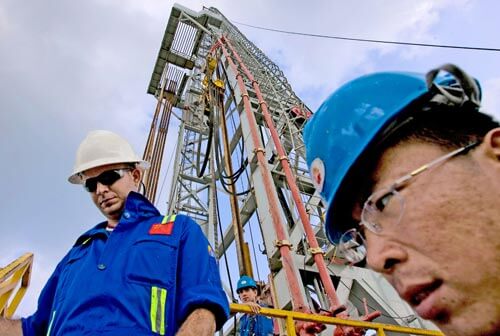
The United States Coast Guard and environmental safety officials have inspected and approved an offshore oil drilling platform headed to Cuba, under an unusual arrangement designed to allay concerns about a possible spill that could foul the U.S. coastline.
Officials said on Jan. 12 that personnel from the Coast Guard and the Department of Interior’s Bureau of Safety and Environmental Enforcement (BSEE) inspected the Scarabeo-9 platform off the coast of Trinidad and Tobago.
“The review is consistent with U.S. efforts to minimize the possibility of a major oil spill, which would hurt U.S. economic and environmental interests,” said the Interior Department in a statement.
Plans by the Spanish-based Repsol YPF oil company to use the platform to drill off Cuba’s northwestern shores, about 70 miles from the Florida Keys, have sparked U.S. concerns about a spill, as well as the U.S. embargo’s impact on efforts to control any damages.
To ease the worries, Repsol invited the U.S. inspectors to check out the platform before it arrives in Cuba and has promised to meet all U.S. requirements when it starts to drill, even though Scarabeo will be operating in Cuba’s Exclusive Economic Zone.
The Scarabeo platform was built in China, with less than 10 percent of its components made in the United States, specifically to sidestep the U.S. commercial embargo on the Spanish-speaking Caribbean island.
The Interior Department said the inspectors “reviewed vessel construction, drilling equipment, and safety systems – including lifesaving and firefighting equipment, emergency generators, dynamic positioning systems, machinery spaces, and the blowout preventer.
“The review compared the vessel with applicable international safety and security standards as well as U.S. standards for drilling units operating in the U.S. Outer Continental Shelf,” it added.
“Personnel found the vessel to generally comply with existing international and U.S. standards by which Repsol has pledged to abide,” said the Interior Department, adding, however, that the review “does not confer any form of certification or endorsement under U.S. or international law.”
Cuba’s plans to drill for oil in deep waters off its northwestern coast have sparked fears among some environmentalists and some U.S. Congress members that oil spilled in Cuban waters could reach U.S. waters and coastlines.
The accident last year at the Deepwater Horizon, an offshore drilling rig similar to the Scarabeo platform, killed 11 workers and spilled hundreds of millions of gallons of crude into the Gulf of Mexico.
Repsol YPF has contracted with the Cuban government for the right to explore in a section of the Straits of Florida that is generally deeper than the area where the Deepwater Horizon exploded and sank.